
How to Calculate Rental Yield on a Property: A Simple Guide for Property Investors

If you are planning to invest in real estate, rental yield is one of the most useful numbers to understand. It helps you estimate how much rental income a property generates compared with its value or purchase price.
Whether you are considering a residential apartment, office, retail space or commercial property, knowing how to calculate rental yield can help you compare different investment opportunities.
What Is Rental Yield?
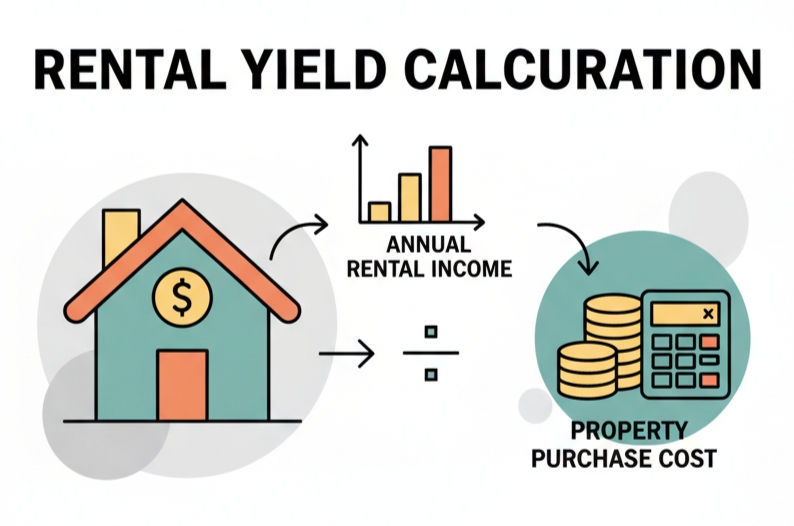
Rental yield is the annual rental income generated by a property, expressed as a percentage of the property's value or purchase price.
In simple terms, it tells you how much income your property generates each year in relation to the amount invested.
For example, a property worth ₹1 crore that generates ₹5 lakh in annual rent has a rental yield of 5%.
How to Calculate Rental Yield
The basic formula is:
Rental Yield (%) = (Annual Rental Income ÷ Property Value) × 100
Example
Suppose you purchase a property for ₹1 crore and receive ₹40,000 per month as rent.
Monthly rent: ₹40,000
Annual rental income: ₹40,000 × 12 = ₹4,80,000
Property value: ₹1,00,00,000
Therefore:
Rental Yield = (₹4,80,000 ÷ ₹1,00,00,000) × 100
Rental Yield = 4.8%
So, the property has a gross rental yield of 4.8% per year.
What Is Gross Rental Yield?
Gross rental yield is the simplest way to calculate rental yield. It considers the annual rent without deducting property-related expenses.
Formula:
Gross Rental Yield = (Annual Rent ÷ Property Value) × 100
It is particularly useful when you want to quickly compare multiple properties.
What Is Net Rental Yield?
For a more realistic picture of your property's income, you can calculate net rental yield by considering expenses.
These may include:
Property maintenance
Property tax
Repairs
Insurance
Property management fees
Vacancy periods
Other recurring property expenses
Example
Suppose:
Annual rent: ₹4,80,000
Annual property expenses: ₹80,000
Net rental income: ₹4,00,000
If the property is worth ₹1 crore:
Net Rental Yield = (₹4,00,000 ÷ ₹1,00,00,000) × 100 = 4%
Therefore, the property's estimated net rental yield is 4%.
Why Is Rental Yield Important?
Rental yield can help property investors:
Compare different investment properties
Estimate potential rental income
Understand the income-generating potential of a property
Evaluate residential and commercial properties
Make more informed investment decisions
However, rental yield should not be the only factor you consider.
A property with a higher rental yield may not necessarily be the better investment if the location has weak demand, limited connectivity or poor long-term prospects.
Rental Yield vs Property Appreciation
When evaluating an investment property, consider two important factors:
1. Rental income – The income you may receive while owning the property.
2. Capital appreciation – The potential increase in the property's value over time.
For example, a property may generate regular rental income while also increasing in value as the surrounding location develops.
This is why investors should evaluate rental yield, property appreciation, location, tenant demand and overall investment costs together.
What Factors Can Affect Rental Yield?
Several factors can influence the rental yield of a property:
Location
Properties in areas with strong residential or commercial demand may command better rents.
Purchase Price
A lower purchase price combined with strong rental income can result in a higher rental yield.
Rental Demand
Properties near offices, business districts, educational institutions, transport hubs and other amenities may attract stronger tenant demand.
Property Type
Residential apartments, offices, shops, showrooms and other commercial properties can have different rental patterns and yields.
Vacancy
A property that remains vacant for extended periods can reduce actual annual rental income.
Operating Expenses
Maintenance, taxes, repairs and management costs can reduce the net income generated by the property.
What Should You Check Before Investing?
Before buying an investment property, don't look at rental yield alone.
Consider:
Location + Purchase Price + Rental Income + Tenant Demand + Expenses + Future Development + Capital Appreciation Potential
A good investment decision comes from evaluating the complete picture rather than focusing on a single percentage.
Thinking about investing in property? Explore the right investment opportunity with Urviventures and make your next real estate investment a well-informed one.
FAQ
What is rental yield?
Rental yield is the annual rental income generated by a property expressed as a percentage of its property value or purchase price.
How do you calculate rental yield?
Divide the property's annual rental income by its value or purchase price and multiply the result by 100.
What is a good rental yield?
There is no single rental yield percentage that is appropriate for every property. It varies depending on the location, property type, purchase price, rental demand, expenses and market conditions.
Is rental yield more important than property appreciation?
Both are important considerations. Rental yield measures potential ongoing rental income, while property appreciation relates to potential growth in the property's value. Investors should consider both along with costs and risks.
What is the difference between gross and net rental yield?
Gross rental yield is calculated using annual rent before expenses. Net rental yield accounts for relevant property expenses and therefore provides a closer view of the income actually generated.
Looking for an investment property with strong rental income and long-term growth potential? Contact Urviventures today and let us help you find the right property for your investment goals.

Comments